Intentional Engagement, Part 2

The more consideration I’ve given to this topic, the more I’ve realized that Dad engaged with us kids (with me, I know) in very intentional ways. When there were serious topics he wanted to discuss, an after supper conversation in the dining room, or going for a ride in the car, or working on a project often provided the time and setting needed for that chat. Whether there were questions for us (me), answers to questions we (I) had asked at some point that he had been pondering, or just general guidance for life and/or godliness, Dad was thorough. I often went to him for advice, and even if he didn’t give it right away, I knew he’d provide input somewhere down the road. More than anything Dad said or did in my presence, though, his prayers for me have been constant.

As a dad myself, I look for ways to emulate my father’s example–and my father-in-law’s example. Both men love God and their children, and they set examples to follow. Intentional love is ultimately the love of God, and as they have tried to obey His commands as Dads, I do that now, too.

A Push Too Far

A one-page snippet written 11/24/2015 during an ELA class to fulfill the assignment, “Write a story that contains a broken wristwatch, peppermints, and a push that goes too far.” While my students wrote, so did I. Here it is:

Robby leaned against a sapling, gasping for air. The little tree bent, then broke, and he fell to the ground, cursing. Pain seared his abdomen. He lifted his shirt to see a scrape across his right side where the shattered sapling had rubbed against him. At least it wasn’t bleeding. A moment’s rest more, and he was on his feet again, running as fast as he could, his thoughts whirling with fear and anguish.

All he’d wanted was a couple of peppermints from his friend; why couldn’t Jamie share? He always shared with Jamie. His lunch, his answers for their homework, a spare coat in chilly weather. And did Jamie ever say thank you or share with him? No. Peppermints were Robby’s favorite candy, and Jamie knew it. He had a whole bag of them, and he wouldn’t even give Robby two. He just taunted Robby and called him a loser.

He offered to let Jamie use his prized possession—the wristwatch his grandfather had given him—if he could have even one peppermint candy. Jamie said yes, and when Robby gave him the watch, Jamie just crushed it with a rock and that’s when Robby lost it. He gave Jamie a push, and then another one. Jamie laughed at him, called him a loser again, and shoved him back. When Robby fell down, Jamie turned and walked away. He didn’t see Robby getting up again and running at him. When Robby hit him, the boys were near the ravine. Jamie stumbled and fell out of sight with a scream. Robby was so shocked at what he’d done that he turned and ran for home.

Several hours later, there was a knock at the door of Robby’s house. His mother answered and then called her son to join her immediately. A police officer stood before him, wanting to know if he’d been to the ravine today, wanting to know if he knew a boy named Jamie, wanting to know if he knew anything about what happened to him.

2. Relationships over Rights: Honoring the Savior

The following is another in the series of Lessons from My Father. This one is a little more rambling than The Wheelbarrow, in part because it contains more than one topic. However, all of the elements in this one pointed me to putting relationships in a more important place in life than my rights or goods. In reality, it is the Second Greatest Commandment: Love your neighbor as yourself.

Dad would rather suffer an injustice than put the screws to someone; I’m confrontational. I recall one summer when I was very young that a potato farmer rented some of our hayfields to plant his crops and then failed to pay the balance of the bill to my parents, or so I was told. From what I understood, Dad preferred not to take the man to court over it, citing Scripture’s command not to sue a fellow believer in a secular setting, so our family was out the money due us. I struggled to maintain a charitable attitude when I learned about getting short-changed like that. On the other hand, Dad was being charitable, sowing mercy, and reaping a harvest of mercy and righteousness that I didn’t comprehend at such a young age. 

Over the years, Dad did his best to assemble the family for family worship after supper. We usually sang and then read a passage from the Bible and prayed. I squirmed. A lot. I don’t know why, exactly, but when I see my sons squirming now, I remember my experience from childhood. I have not done well with this practice at all as a dad, although the boys and I did have several stretches over their younger years when I would read the Bible and pray with them at bedtime.

As a teacher in public school, my father had responsibilities that kept him away from the house some evenings. We lived equidistant from his work, which was west of us, and where we went to school, which was east of us, 30-40 minutes either way, depending on traffic and road conditions. Also, he was an elder in our church, which was east of us, in another part of the same city where we went to school, and he attended meetings there at least once a week, I think. It seemed he was away from home at least two or three evenings a week or had meetings at the house.

We attended Sunday school and church every Sunday morning, and then evening service, too. We also attended prayer meetings or hosted them at our house. It differed over the years. Some of my earliest years, Dad served as pulpit supply at the East Dixmont Community Church. We had just one vehicle, so he’d drive us to Bangor for Sunday school, drop us off, and then drive to East Dixmont for church there. When church was over there, he’d return to Bangor to pick us up and go home for lunch. He did a lot of driving in those days.

It was once such Sunday in the fall of the mid-1970s when we lost the barn. The night before, my brother and I had helped Dad line a room in the barn with bales of mulch hay to make a cozy place for the chickens to spend the winter. We held off on moving the hens that night, though. The next morning, after we left for church, a fire was started. A neighbor noticed it and called the fire department. Then he called our church. Mum got the call just as Sunday school was finishing up. She found a ride for us with someone who had a car large enough for all of us.

As we hurried home, someone else contacted Dad somehow. To this day, I don’t know how he was reached in East Dixmont. They didn’t even have running water or indoor plumbing in their church.

Today, nearly 42 years after the fact, I can still picture the cars and trucks lining both sides of the road of the final quarter mile to our house, blocked from continuing due to the ferocity of the fire. When our driver tried to proceed, a fireman stopped him. Our friend rolled down his window and Mum shouted to the fireman, “That’s my barn!” He let us through.

I sat by the three trees at the corner of the driveway and watched the barn burn. Dad arrived home just as the roof collapsed. The entire season’s hay was gone, hay that would have been sold to pay our Christian school tuition. Of far greater concern to Dad was that a neighbor had parked some farming equipment in the barn for safekeeping for the winter, and that had burned up, too. At some point, a dead tree behind the barn caught fire, broke off, and rolled down the hill into an uncut field, causing it to light up. A firetruck had to be driven down there to put out that blaze. The State Fire Marshal was never able to pinpoint a cause, though he suspected arson.

Dad was more concerned about his relationship with the neighboring farmer than with the material loss we suffered. By God’s grace, the other man was also a believer, and was a forgiving man. It helped that the barn was insured, but it took me a long time to comprehend that relationships are more important than materials, a lesson well demonstrated by my father’s reaction to our barn fire.

The Wheelbarrow

Lessons from My Father. The Wheelbarrow. November 9, 2020. Bill MacDonald.

The Wheelbarrow

“When I was a child, I talked like a child, I reasoned like a child. When I became a man, I put childish ways behind me.”

Dad quoted this verse from First Corinthians 13 to me more than a decade ago when I commented on not minding haying anymore, but these words from verse eleven came back to me this morning as I remembered the wheelbarrow he made.

On my drive to work today, I passed a driveway that had a large handcart at the mouth of it, piled high with bags of trash. The cart had fat, rubber tires, and I imagined it could be pushed as easily over soft ground as on the pavement. Instantly, images of Dad’s wheelbarrow flashed into my head, and shame filled my heart.

“When I was a child…I reasoned like a child.” I recall that I complained excessively as a child, especially about physical labors required of me. They were not harsh measures, just everyday expectations of a growing boy, such as splitting and stacking firewood, mowing the lawn, gathering maple sap, and haying. One result of my plaintive pleas was that Dad made a wheelbarrow to ease the movement of the fruits of my labors. It was truly impressive, and I should have been grateful, but I wasn’t. Instead, I complained even more, because it didn’t have a fat, rubber tire. It had a flat-iron wheel that ran fine on hard surfaces but became hopelessly mired in soft ones. Rather than expressing gratitude to Dad for his creativity and love, I whined all the more that it wasn’t enough. In an instant this morning, all these images and thoughts rushed through me, with shame following in a blast.

In truth, with just a little more effort on my part, that wheelbarrow would have pushed through any mire, or I could have found better paths for it, but in my slothful discontented childishness, it was easier to grumble than to be grateful. Forty years later, I remember with sorrow the sins of my youth. My Father graced me with his gifts, and I responded with ingratitude.

Is that not the way of life? As Dad pointed out, First Corinthians 13 is more famously known for its description of what Love is and is not. Yet, verse 11 is poignant because it challenges us to grow up; not to remain in the “baby Christian” stage of life, always requiring the milk of basic teachings, but to chew on the meat of God’s Word, meditating on it for daily life. Wrestle with sin; recognize the Holy Spirit’s power to overcome ingratitude in us and make us thankful people—thankful to God the Father, Son, and Holy Spirit for new life in Jesus that reconciles us to God and to one another. First John 1:9 is that wonderful promise: “If we confess our sins, he is faithful and just and will forgive us our sins and purify us from all unrighteousness.”

Dad, I’m sorry that I was such a complaining, ungrateful child. Thank you for loving me, anyway. Please forgive me. I love you!

Humbly yours,

Bill

Intentional Engagement, Part 1

Twice in the past week, I have been complimented on my intentional engagement as a dad with my two sons, who are 14 and 12, respectively. The first time was by my brother, who is six years older than I am, and who has always been a role model for me. The other was by a friend I’ve known since kindergarten. Her comment was prompted by this post on social media:

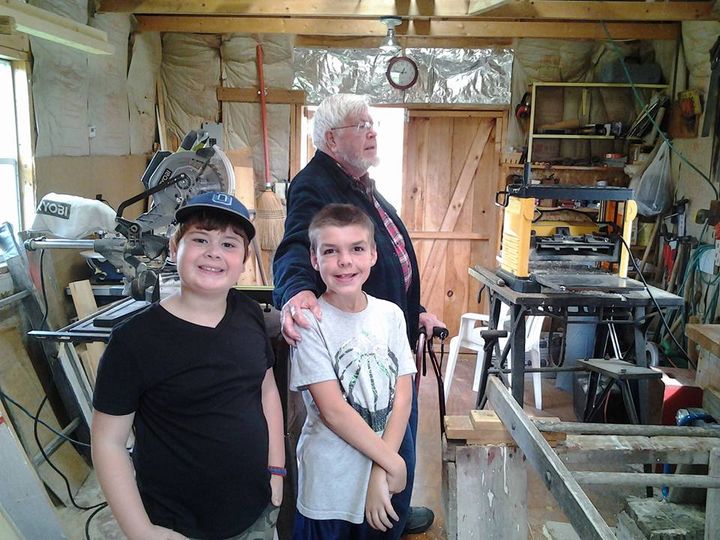
“M got his hair dyed today. I wanted to take a picture, and he resisted. Eventually, he consented. Then I explained why I’m always taking pictures of him and his brother.There isn’t an abundance of photos of my childhood to show them to demonstrate my upbringing and memories. I want it to be different for them. As we talked, and he looked at pictures on my FB account, he found himself lost in laughs and memories, just as I’d hoped.Here’s one from a few years ago, on this day. Grandpa isn’t as active as this anymore, and I want them to remember these things about him.”

When I was reminiscing with my brother last week, we recalled how our Dad, whom we love very much, connected with us differently than we have with our own sons. And my brother said to me that even he wasn’t as intentional with his boys as I’ve been with mine. I guess I have my own reasons for it, which mold and shape me as a father. I’m certainly not perfect! However, I have always had in it in my heart to be intentional in connecting with my sons so that when they are grown up they will remember their childhoods as times of positive interaction with their father (to go with the negative interactions that occur, too).

On a Rainy Afternoon

October 7, 2020

The rain drums steadily on the roof. Beyond the next wall, a virtual classroom instructor’s voice drones through the speakers like Charlie Brown’s teacher: “Wah, wah wah wah. Wah. Wah.” A door in the hallway rattles as it is opened, and then it bangs shut. Florescent lights above my head whine, pulsating with the pain behind my eyes.  The two-way radio crackles to life, a predictable disruption in this house of correction. I gaze around the room; beige plastic-molded chairs sit at tan wooden tables on a speckled tile floor, surrounded by off-white concrete block walls. Dreary hardly begins to describe it. Posters of nature scenes, the Bill of Rights, Branches of the U.S. Government, and other images make efforts to break through the drab discoloration, but the pasty clutter threatens to win the day. After having faded into the background, the rains pick up again, their crescendo and decrescendo toying with the listener, harkening to memories of cuddles with books, blankets, and hot chocolate.

Sometimes

Sep 15

Sometimes I feel old
over the hill
worn out
ready to throw in the towel

Sometimes I feel young
just beginning life
not yet in my prime
raring to get going

Sometimes I don’t feel at all
conscious of each breath
hearing the most silent sounds of silence
unsure what to do next

Where I am today 
I may not be tomorrow
Where I am tomorrow
I may not be next week

The ebbs and flows of life
and emotion 
leave
me
paralyzed

Sometimes

When friendships die

I had a friend. He was handsome and smart. He had a great smile, an infectious laugh, and the ability to make others comfortable around him, even if they didn’t understand the situation as well as he seemed to. He didn’t put others down. He never belittled, and in spite of his superior processing abilities, I never felt inferior to him. He helped me pass some difficult classes in high school, in particular, and I’ve never forgotten his patience with me when I struggled to understand concepts and procedures. 

I had a friend. We attended the same church, went to Bible conference together, talked the weighty matters of God and faith. He seemed to be firmly held by his walk with the Lord, and I admired him for it. We ended up at different high schools after freshman year and began to drift apart, but I still had that friend. Church, Bible camp, and youth group kept us together. 

I had a friend. His family moved down South. It was hard to see them go; I was friends with his brothers, too, but he was my age. A few years passed, and my friend came to Maine and introduced me to his fiancée. She seemed very pleasant. He was as handsome and dashing as ever, still the great smile. However, something had changed in him, and we no longer saw eye-to-eye. Hints of conversation displayed seams of disagreement that I hadn’t observed before. Biblical orthodoxy was no longer preeminent for him. Right and wrong had become a matter of choice rather than measured by the standard of God’s Word. 

I had a friend. We lost touch for many years. He married and had children, I knew, but I had followed little else. Just a few years ago, I received the sad news that his older brother had died of a heart attack while on the job as a police officer. My friend and I reconnected; he sent me livestream video of the funeral and the tribute parade. A few months later, he called me to reveal deeply personal news of his own. By the end of the conversation, I inquired what name and pronoun my friend preferred. She told me. In the course of the conversation, I had learned that she had left her professed Christian faith many years before and had a humanistic worldview. She knew I would not agree nor affirm her new beliefs and lifestyle, but she hoped I would not judge her. I told her God is the judge, not me. I would do my best to honor our friendship. 

I had a friend. For three years I have tried to honor our lifelong friendship in spite of the radical changes that have occurred in it. However, the man that had never belittled, never put down, always had kind words for others to build them up has been replaced by a woman that often berates, often belittles, rarely has encouraging words for my other friends and me, and that is not friendship. It is poisonous toxicity. The winning smile is gone, replaced by frowns of displeasure. The friendship has died.

I had a friend. 

Little changes can be tough, too

Not all of life’s changes that bring on stress are big changes. When I finished substitute teaching at the youth development center in 2013 and became a full time teacher there, I was assigned to a particular classroom that has been my home ever since. By the beginning of 2015, the facility was no longer a youth development center; it was a medium security prison for men. I’ve stayed in my job, helping men progress in their education and/or obtaining a high school equivalency diploma for the last 7 years while working from the same classroom.

Early in 2020, I was told that I would be giving up my classroom and swapping with another teacher. I think I was more upset with the manner in which the decision was relayed to me than with the actual decision, but I duly pouted for several weeks while I pondered how to grow up and put my big boy pants on to make the situation work better for me. As June began, I realized that the other teacher and I had similar class schedule changes happening late in the month, so it would be the ideal time to make the switch happen. He agreed, so we began the process on June 19th and finished in today, the 24th.

Some of our inmate students helped with the heavy lifting, but my colleague and I did our share, too. And as much as I dreaded the change, I’ve already discovered that I like my new setup very much. It really wasn’t a big change, but it brought on a lot of distress. I’ve tried not to complain, because the men I teach face greater changes than this every day and have less control over how they handle those changes than I did over this. I’ve tried to stress the positives about this room swap and the good reasons for my friend to have my old classroom (direct access to the Library, where he and the other teacher co-teach a number of classes, for example).

The biggest drawback of the switch-off is that when we traded room keys, I lost access to the hallway bathroooms! Now I have limited bathroom access and have to plan my breaks more carefully (staff bathrooms are kept locked). I may have to see if I can get a bathroom key from the officer in charge of keys. The second biggest drawback is that my old classroom had a sink, because waaaaaaaay back in the day, that room was the culinary classroom. I used to wash out my lunch utensils and refill my water bottle, as well as wash my hands or give my students a cup of water when needed. Still, I have a bigger classroom now, with more accessible closets and a better setup for my desk and teacher corner.

All of us have little changes we have to deal with all the time, and some of them cause us stress. We anticipate that the change will bring difficulty for us, and we decide with prejudice–pre-judging–that the change, therefore, is bad. That makes us resist, or want to resist, whatever the change will be. When we pause and think about what may be good about the change, we often find that we’ve been stuck in a rut and need to move out of our comfort zones, or that we need to be challenged to think of others instead of just ourselves.

This classroom change will help my coworkers meet the needs of their students better than before, and I’ll still be able to meet my students’ needs. In fact, during the course of the move, I discovered materials I’ve needed for my classes, so I can be more effective in helping my students. We need to be open minded about change, and that is not our natural tendency. Personally, I have to trust God that being open to change means that He will change me to make me more like Him: More loving, more gracious, more holy, more righteous, more tender, more thoughtful, more patient, and in all other ways more like Jesus. By doing so, with my eyes fixed on the Author and Finisher of faith, my heart, mind, and life will be filled with peace, and there will be no room for stress about a classroom swap or anything else.