Another view of Tolkien

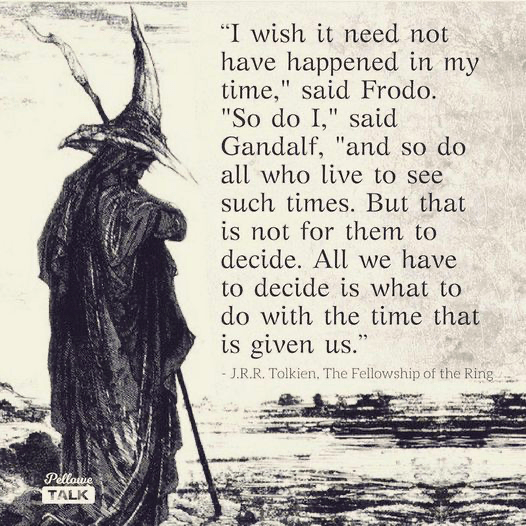
My former boss shared this from Tolkien, which my wise sister has shared on occasion, as well, and it is a hearty reminder of the providence of God for the times in which we live:

I’m fairly certain, however, that my former boss–whom I admire greatly and count as the best boss I’ve ever worked for–might disagree with the premise I see in Tolkien’s words here. It is likely common knowledge to Tolkien was very dismissive of his friend C.S. Lewis’s penchant for allegorical writing, and is known for saying that his Christian faith was not on display in his own books. However, as numerous scholars have suggested, and as I have seen for myself in careful readings of his books (as well as knowing what it means to be a Christian) I think Tolkien protested a bit too much about that.

While Tolkien’s Christian worldview was not overtly on display in the way Lewis’s was in the Chronicles of Narnia, the quote above and one from my previous post on “A Sister’s Wisdom” demonstrate elements of God’s providences for His people to recognize their roles in life as their Sovereign carries forward His plan of redemption in the lives of humankind. We frequently don’t feel up to the task as Frodo expressed, nor do we believe we are strong enough to hold back the evil that is upon us, but we are called to everyday obedience, everyday submission to God, everyday kindness and prayer, everyday forgiveness and grace. When we rest in the confidence that our God will bring the results that He desires, then we will walk day by day in greater peace than we’ve known before.

A Sister’s Wisdom

I have three older sisters, and I did not always believe that they were wise, but somewhere along the way, I grew up (and so did they), and I am so very thankful to be their baby brother. The one with whom I sparred the most growing up has become the one with whom I interact the most often in our adult years. I don’t love her more than I love my other sisters–I love them equally much! Yet, our interactions are almost daily, via social media.

She posts many quotes from authors and literary characters that are sometimes witty but more often poignant or providentially timely. It was she who prompted me to show an interest in the writings of J.R.R. Tolkien, including the Hobbit, the Lord of the Rings trilogy, and the Silmarillion. What powerful stories he wove! When the movies for LOTR came out, I enjoyed them to an extent, but so much of the full tale was lost or altered that I was driven to the books again to restore my fulfillment of the original stories.

My sister’s interest in Tolkien and his characters frequently appears in her posted quotes, as the battles of good vs. evil in his stories so often reflect the real world in which Tolkien lived, and which in turn, we live. Fighting evil seems so overwhelming at times that we often feel ill-prepared nor up to the task. Yet we must not despair of doing right.

In Galatians 6:9, the Apostle Paul reminds the Christians at Galatia of the solemn duty God gives his people: “And let us not grow weary of doing good, for in due season we will reap, if we do not give up.” How do we fight the evil in the world? How does this work itself out in daily life? I think of this verse when my sister posts the following meme on social media:

The One Thing for 2021

Through our pastor’s sermon yesterday morning, God challenged me to consider what the One Thing is that I desire most for 2021. That is, if fill-in-the-blank would happen, it would make 2021 the best year possible.

Then he said, if your answer is anything except the Creator, that’s your god. In verse 4 of this Psalm, David declares–in the midst of terrors, trials, uncertainties, and hardships–that the One Thing he desires is to gaze upon the beauty of the Lord. He exhorted us to consider that setting aside all created things for the beholding the beauty of the Creator will fill us with a greater understanding of being held in the stronghold that is Jesus Christ than we could ever find in pursuit of any earthly gain.

When challenged yesterday, I was saddened to realize that I had something else in mind as an answer to the question. However, God never leaves us in our sinfulness, so with the Psalmist, I make this my prayer, and like the Apostle Paul in Philippians 3:14, “I press on toward the goal for the prize of the upward call of God in Christ Jesus”:

Psalm 27

The Lord Is My Light and My Salvation; Of David.

1 The Lord is my light and my salvation; whom shall I fear? The Lord is the stronghold of my life; of whom shall I be afraid?

2 When evildoers assail me to eat up my flesh, my adversaries and foes, it is they who stumble and fall.

3 Though an army encamp against me, my heart shall not fear; though war arise against me, yet I will be confident.

4 One thing have I asked of the Lord, that will I seek after: that I may dwell in the house of the Lord all the days of my life, to gaze upon the beauty of the Lord and to inquire in his temple.

5 For he will hide me in his shelter in the day of trouble; he will conceal me under the cover of his tent; he will lift me high upon a rock.

6 And now my head shall be lifted up above my enemies all around me, and I will offer in his tent sacrifices with shouts of joy; I will sing and make melody to the Lord.

7 Hear, O Lord, when I cry aloud; be gracious to me and answer me!

8 You have said, “Seek my face.” My heart says to you, “Your face, Lord, do I seek.”

9 Hide not your face from me. Turn not your servant away in anger, O you who have been my help. Cast me not off; forsake me not, O God of my salvation!

10 For my father and my mother have forsaken me, but the Lord will take me in.

11 Teach me your way, O Lord, and lead me on a level path because of my enemies.

12 Give me not up to the will of my adversaries; for false witnesses have risen against me, and they breathe out violence.

13 I believe that I shall look upon the goodness of the Lord in the land of the living!

14 Wait for the Lord; be strong, and let your heart take courage; wait for the Lord!

https://www.sermonaudio.com/sermon/1821153925285

Early Rain: A Plea and a Declaration

As I post this to social media, I call on Christians across America to substitute our own country and people wherever China and Chinese are mentioned. For decades we have seen ourselves as part of a privileged nation (I am guilty of this, too), and the Lord has certainly blessed us in many ways, but by and large we have given ourselves over to trust in princes rather than in Christ Jesus, and we are reaping the whirlwind for that sin. Our most recent presidential election featured two immoral men from which to choose—which one was less bad? In either choice, we get someone deeply flawed. It is way past time for Christians in America to stop looking to political officials to establish justice in this country, and for us to act justly ourselves, to show mercy ourselves, and walk humbly in Christ ourselves. Read the translation of this Declaration of Faithful Disobedience by Pastor Wang Yi, now imprisoned in China for preaching the Gospel of Jesus Christ, and tell me if you are not moved by the truth of his words, including these: “This is why I am not interested in changing any political or legal institutions in China. I’m not even interested in the question of when the Communist regime’s policies persecuting the church will change. Regardless of which regime I live under now or in the future, as long as the secular government continues to persecute the church, violating human consciences that belong to God alone, I will continue my faithful disobedience.”

~Bill MacDonald, 12/9/20.

12/9/20, posted on Facebook by Early Rain Covenant Church.

Today marks the two-year anniversary of the raid on Early Rain Covenant Church, in which Chinese authorities jailed more than 50 members and detained dozens more. Although most of these Christians have since been released, Pastor Wang Yi and Elder Qin Defu remain in prison. Pastor Wang Yi was sentenced to nine years and Elder Qin Defu to four. Other church members continue to suffer threats and harassment by authorities as they are still officially forbidden from meeting together. Please pray for this church and for their families today as they bear this reproach for the sake of Christ. Below is the letter Pastor Wang Yi wrote to be published at his arrest. May his words continue to encourage and convict us.

**************************

My Declaration of Faithful Disobedience

On the basis of the teachings of the Bible and the mission of the gospel, I respect the authorities God has established in China. For God deposes kings and raises up kings. This is why I submit to the historical and institutional arrangements of God in China.

As a pastor of a Christian church, I have my own understanding and views, based on the Bible, about what righteous order and good government is. At the same time, I am filled with anger and disgust at the persecution of the church by this Communist regime, at the wickedness of their depriving people of the freedoms of religion and of conscience. But changing social and political institutions is not the mission I have been called to, and it is not the goal for which God has given his people the gospel.

For all hideous realities, unrighteous politics, and arbitrary laws manifest the cross of Jesus Christ, the only means by which every Chinese person must be saved. They also manifest the fact that true hope and a perfect society will never be found in the transformation of any earthly institution or culture but only in our sins being freely forgiven by Christ and in the hope of eternal life.

As a pastor, my firm belief in the gospel, my teaching, and my rebuking of all evil proceeds from Christ’s command in the gospel and from the unfathomable love of that glorious King. Every man’s life is extremely short, and God fervently commands the church to lead and call any man to repentance who is willing to repent. Christ is eager and willing to forgive all who turn from their sins. This is the goal of all the efforts of the church in China—to testify to the world about our Christ, to testify to the Middle Kingdom about the Kingdom of Heaven, to testify to earthly, momentary lives about heavenly, eternal life. This is also the pastoral calling that I have received.

For this reason, I accept and respect the fact that this Communist regime has been allowed by God to rule temporarily. As the Lord’s servant John Calvin said, wicked rulers are the judgment of God on a wicked people, the goal being to urge God’s people to repent and turn again toward Him. For this reason, I am joyfully willing to submit myself to their enforcement of the law as though submitting to the discipline and training of the Lord.

At the same time, I believe that this Communist regime’s persecution against the church is a greatly wicked, unlawful action. As a pastor of a Christian church, I must denounce this wickedness openly and severely. The calling that I have received requires me to use non-violent methods to disobey those human laws that disobey the Bible and God. My Savior Christ also requires me to joyfully bear all costs for disobeying wicked laws.

But this does not mean that my personal disobedience and the disobedience of the church is in any sense “fighting for rights” or political activism in the form of civil disobedience, because I do not have the intention of changing any institutions or laws of China. As a pastor, the only thing I care about is the disruption of man’s sinful nature by this faithful disobedience and the testimony it bears for the cross of Christ.

As a pastor, my disobedience is one part of the gospel commission. Christ’s great commission requires of us great disobedience. The goal of disobedience is not to change the world but to testify about another world.

For the mission of the church is only to be the church and not to become a part of any secular institution. From a negative perspective, the church must separate itself from the world and keep itself from being institutionalized by the world. From a positive perspective, all acts of the church are attempts to prove to the world the real existence of another world. The Bible teaches us that, in all matters relating to the gospel and human conscience, we must obey God and not men. For this reason, spiritual disobedience and bodily suffering are both ways we testify to another eternal world and to another glorious King.

This is why I am not interested in changing any political or legal institutions in China. I’m not even interested in the question of when the Communist regime’s policies persecuting the church will change. Regardless of which regime I live under now or in the future, as long as the secular government continues to persecute the church, violating human consciences that belong to God alone, I will continue my faithful disobedience. For the entire commission God has given me is to let more Chinese people know through my actions that the hope of humanity and society is only in the redemption of Christ, in the supernatural, gracious sovereignty of God.

If God decides to use the persecution of this Communist regime against the church to help more Chinese people to despair of their futures, to lead them through a wilderness of spiritual disillusionment and through this to make them know Jesus, if through this he continues disciplining and building up his church, then I am joyfully willing to submit to God’s plans, for his plans are always benevolent and good.

Precisely because none of my words and actions are directed toward seeking and hoping for societal and political transformation, I have no fear of any social or political power. For the Bible teaches us that God establishes governmental authorities in order to terrorize evildoers, not to terrorize doers of good. If believers in Jesus do no wrong then they should not be afraid of dark powers. Even though I am often weak, I firmly believe this is the promise of the gospel. It is what I’ve devoted all of my energy to. It is the good news that I am spreading throughout Chinese society.

I also understand that this happens to be the very reason why the Communist regime is filled with fear at a church that is no longer afraid of it.

If I am imprisoned for a long or short period of time, if I can help reduce the authorities’ fear of my faith and of my Savior, I am very joyfully willing to help them in this way. But I know that only when I renounce all the wickedness of this persecution against the church and use peaceful means to disobey, will I truly be able to help the souls of the authorities and law enforcement. I hope God uses me, by means of first losing my personal freedom, to tell those who have deprived me of my personal freedom that there is an authority higher than their authority, and that there is a freedom that they cannot restrain, a freedom that fills the church of the crucified and risen Jesus Christ.

Regardless of what crime the government charges me with, whatever filth they fling at me, as long as this charge is related to my faith, my writings, my comments, and my teachings, it is merely a lie and temptation of demons. I categorically deny it. I will serve my sentence, but I will not serve the law. I will be executed, but I will not plead guilty.

Moreover, I must point out that persecution against the Lord’s church and against all Chinese people who believe in Jesus Christ is the most wicked and the most horrendous evil of Chinese society. This is not only a sin against Christians. It is also a sin against all non-Christians. For the government is brutally and ruthlessly threatening them and hindering them from coming to Jesus. There is no greater wickedness in the world than this.

If this regime is one day overthrown by God, it will be for no other reason than God’s righteous punishment and revenge for this evil. For on earth, there has only ever been a thousand-year church. There has never been a thousand-year government. There is only eternal faith. There is no eternal power.

Those who lock me up will one day be locked up by angels. Those who interrogate me will finally be questioned and judged by Christ. When I think of this, the Lord fills me with a natural compassion and grief toward those who are attempting to and actively imprisoning me. Pray that the Lord would use me, that he would grant me patience and wisdom, that I might take the gospel to them.

Separate me from my wife and children, ruin my reputation, destroy my life and my family – the authorities are capable of doing all of these things. However, no one in this world can force me to renounce my faith; no one can make me change my life; and no one can raise me from the dead.

And so, respectable officers, stop committing evil. This is not for my benefit but rather for yours and your children’s. I plead earnestly with you to stay your hands, for why should you be willing to pay the price of eternal damnation in hell for the sake of a lowly sinner such as I?

Jesus is the Christ, son of the eternal, living God. He died for sinners and rose to life for us. He is my king and the king of the whole earth yesterday, today, and forever. I am his servant, and I am imprisoned because of this. I will resist in meekness those who resist God, and I will joyfully violate all laws that violate God’s laws.

“How do you stop rambling?

I was asked that question today in class by a man that is known as a classic rambler. I didn’t give him an answer. Instead, I asked him some questions seemingly unrelated to the matter and then read a story to him. He likes the short essay tales that I write, and it seemed a good way to conclude our time together this morning.

Rambling conversations are wearisome. I know that because I’m frequently guilty of causing them. In truth, they aren’t typically conversations; they’re monologues. Actually patient listeners will stay eyes-on the talker all the way through, but the semi-patient (like me) will “listen” while “multi-tasking.” It’s too similar to reading a Stephen King novel in which his unnecessary attention to nitty-gritty detail for mundane matters makes my eyes and mind glaze over, and I begin skimming over paragraphs to return to real dialogue or action.

The more self-aware I become of my tendencies to rambling, the more intentional I attempt to be at getting to the point. I definitely have a mixed record on this, but I think I’m making positive progress. I ask myself if my listener really needs to know every scrap of detail, or if he or she just needs the bottom line? On the other hand, do I have a need to express more than just the bottom line? If so, can I find another way to do that? Do I have to do it in conversation? Can I write it instead?

I can certainly put it in a blog that virtually no one reads. Spill my thoughts here, get them out of my head, leave them on the electronic page, declutter my brain, and free up my emotions for healthier employments. Perhaps then, with a clear head and mind, I can speak concisely and to the point, ramble-free, and find a way to help my student learn to do the same.

Intentional Engagement, Part 2

The more consideration I’ve given to this topic, the more I’ve realized that Dad engaged with us kids (with me, I know) in very intentional ways. When there were serious topics he wanted to discuss, an after supper conversation in the dining room, or going for a ride in the car, or working on a project often provided the time and setting needed for that chat. Whether there were questions for us (me), answers to questions we (I) had asked at some point that he had been pondering, or just general guidance for life and/or godliness, Dad was thorough. I often went to him for advice, and even if he didn’t give it right away, I knew he’d provide input somewhere down the road. More than anything Dad said or did in my presence, though, his prayers for me have been constant.

As a dad myself, I look for ways to emulate my father’s example–and my father-in-law’s example. Both men love God and their children, and they set examples to follow. Intentional love is ultimately the love of God, and as they have tried to obey His commands as Dads, I do that now, too.

A Push Too Far

A one-page snippet written 11/24/2015 during an ELA class to fulfill the assignment, “Write a story that contains a broken wristwatch, peppermints, and a push that goes too far.” While my students wrote, so did I. Here it is:

Robby leaned against a sapling, gasping for air. The little tree bent, then broke, and he fell to the ground, cursing. Pain seared his abdomen. He lifted his shirt to see a scrape across his right side where the shattered sapling had rubbed against him. At least it wasn’t bleeding. A moment’s rest more, and he was on his feet again, running as fast as he could, his thoughts whirling with fear and anguish.

All he’d wanted was a couple of peppermints from his friend; why couldn’t Jamie share? He always shared with Jamie. His lunch, his answers for their homework, a spare coat in chilly weather. And did Jamie ever say thank you or share with him? No. Peppermints were Robby’s favorite candy, and Jamie knew it. He had a whole bag of them, and he wouldn’t even give Robby two. He just taunted Robby and called him a loser.

He offered to let Jamie use his prized possession—the wristwatch his grandfather had given him—if he could have even one peppermint candy. Jamie said yes, and when Robby gave him the watch, Jamie just crushed it with a rock and that’s when Robby lost it. He gave Jamie a push, and then another one. Jamie laughed at him, called him a loser again, and shoved him back. When Robby fell down, Jamie turned and walked away. He didn’t see Robby getting up again and running at him. When Robby hit him, the boys were near the ravine. Jamie stumbled and fell out of sight with a scream. Robby was so shocked at what he’d done that he turned and ran for home.

Several hours later, there was a knock at the door of Robby’s house. His mother answered and then called her son to join her immediately. A police officer stood before him, wanting to know if he’d been to the ravine today, wanting to know if he knew a boy named Jamie, wanting to know if he knew anything about what happened to him.

2. Relationships over Rights: Honoring the Savior

The following is another in the series of Lessons from My Father. This one is a little more rambling than The Wheelbarrow, in part because it contains more than one topic. However, all of the elements in this one pointed me to putting relationships in a more important place in life than my rights or goods. In reality, it is the Second Greatest Commandment: Love your neighbor as yourself.

Dad would rather suffer an injustice than put the screws to someone; I’m confrontational. I recall one summer when I was very young that a potato farmer rented some of our hayfields to plant his crops and then failed to pay the balance of the bill to my parents, or so I was told. From what I understood, Dad preferred not to take the man to court over it, citing Scripture’s command not to sue a fellow believer in a secular setting, so our family was out the money due us. I struggled to maintain a charitable attitude when I learned about getting short-changed like that. On the other hand, Dad was being charitable, sowing mercy, and reaping a harvest of mercy and righteousness that I didn’t comprehend at such a young age. 

Over the years, Dad did his best to assemble the family for family worship after supper. We usually sang and then read a passage from the Bible and prayed. I squirmed. A lot. I don’t know why, exactly, but when I see my sons squirming now, I remember my experience from childhood. I have not done well with this practice at all as a dad, although the boys and I did have several stretches over their younger years when I would read the Bible and pray with them at bedtime.

As a teacher in public school, my father had responsibilities that kept him away from the house some evenings. We lived equidistant from his work, which was west of us, and where we went to school, which was east of us, 30-40 minutes either way, depending on traffic and road conditions. Also, he was an elder in our church, which was east of us, in another part of the same city where we went to school, and he attended meetings there at least once a week, I think. It seemed he was away from home at least two or three evenings a week or had meetings at the house.

We attended Sunday school and church every Sunday morning, and then evening service, too. We also attended prayer meetings or hosted them at our house. It differed over the years. Some of my earliest years, Dad served as pulpit supply at the East Dixmont Community Church. We had just one vehicle, so he’d drive us to Bangor for Sunday school, drop us off, and then drive to East Dixmont for church there. When church was over there, he’d return to Bangor to pick us up and go home for lunch. He did a lot of driving in those days.

It was once such Sunday in the fall of the mid-1970s when we lost the barn. The night before, my brother and I had helped Dad line a room in the barn with bales of mulch hay to make a cozy place for the chickens to spend the winter. We held off on moving the hens that night, though. The next morning, after we left for church, a fire was started. A neighbor noticed it and called the fire department. Then he called our church. Mum got the call just as Sunday school was finishing up. She found a ride for us with someone who had a car large enough for all of us.

As we hurried home, someone else contacted Dad somehow. To this day, I don’t know how he was reached in East Dixmont. They didn’t even have running water or indoor plumbing in their church.

Today, nearly 42 years after the fact, I can still picture the cars and trucks lining both sides of the road of the final quarter mile to our house, blocked from continuing due to the ferocity of the fire. When our driver tried to proceed, a fireman stopped him. Our friend rolled down his window and Mum shouted to the fireman, “That’s my barn!” He let us through.

I sat by the three trees at the corner of the driveway and watched the barn burn. Dad arrived home just as the roof collapsed. The entire season’s hay was gone, hay that would have been sold to pay our Christian school tuition. Of far greater concern to Dad was that a neighbor had parked some farming equipment in the barn for safekeeping for the winter, and that had burned up, too. At some point, a dead tree behind the barn caught fire, broke off, and rolled down the hill into an uncut field, causing it to light up. A firetruck had to be driven down there to put out that blaze. The State Fire Marshal was never able to pinpoint a cause, though he suspected arson.

Dad was more concerned about his relationship with the neighboring farmer than with the material loss we suffered. By God’s grace, the other man was also a believer, and was a forgiving man. It helped that the barn was insured, but it took me a long time to comprehend that relationships are more important than materials, a lesson well demonstrated by my father’s reaction to our barn fire.

The Wheelbarrow

Lessons from My Father. The Wheelbarrow. November 9, 2020. Bill MacDonald.

The Wheelbarrow

“When I was a child, I talked like a child, I reasoned like a child. When I became a man, I put childish ways behind me.”

Dad quoted this verse from First Corinthians 13 to me more than a decade ago when I commented on not minding haying anymore, but these words from verse eleven came back to me this morning as I remembered the wheelbarrow he made.

On my drive to work today, I passed a driveway that had a large handcart at the mouth of it, piled high with bags of trash. The cart had fat, rubber tires, and I imagined it could be pushed as easily over soft ground as on the pavement. Instantly, images of Dad’s wheelbarrow flashed into my head, and shame filled my heart.

“When I was a child…I reasoned like a child.” I recall that I complained excessively as a child, especially about physical labors required of me. They were not harsh measures, just everyday expectations of a growing boy, such as splitting and stacking firewood, mowing the lawn, gathering maple sap, and haying. One result of my plaintive pleas was that Dad made a wheelbarrow to ease the movement of the fruits of my labors. It was truly impressive, and I should have been grateful, but I wasn’t. Instead, I complained even more, because it didn’t have a fat, rubber tire. It had a flat-iron wheel that ran fine on hard surfaces but became hopelessly mired in soft ones. Rather than expressing gratitude to Dad for his creativity and love, I whined all the more that it wasn’t enough. In an instant this morning, all these images and thoughts rushed through me, with shame following in a blast.

In truth, with just a little more effort on my part, that wheelbarrow would have pushed through any mire, or I could have found better paths for it, but in my slothful discontented childishness, it was easier to grumble than to be grateful. Forty years later, I remember with sorrow the sins of my youth. My Father graced me with his gifts, and I responded with ingratitude.

Is that not the way of life? As Dad pointed out, First Corinthians 13 is more famously known for its description of what Love is and is not. Yet, verse 11 is poignant because it challenges us to grow up; not to remain in the “baby Christian” stage of life, always requiring the milk of basic teachings, but to chew on the meat of God’s Word, meditating on it for daily life. Wrestle with sin; recognize the Holy Spirit’s power to overcome ingratitude in us and make us thankful people—thankful to God the Father, Son, and Holy Spirit for new life in Jesus that reconciles us to God and to one another. First John 1:9 is that wonderful promise: “If we confess our sins, he is faithful and just and will forgive us our sins and purify us from all unrighteousness.”

Dad, I’m sorry that I was such a complaining, ungrateful child. Thank you for loving me, anyway. Please forgive me. I love you!

Humbly yours,

Bill

Intentional Engagement, Part 1

Twice in the past week, I have been complimented on my intentional engagement as a dad with my two sons, who are 14 and 12, respectively. The first time was by my brother, who is six years older than I am, and who has always been a role model for me. The other was by a friend I’ve known since kindergarten. Her comment was prompted by this post on social media:

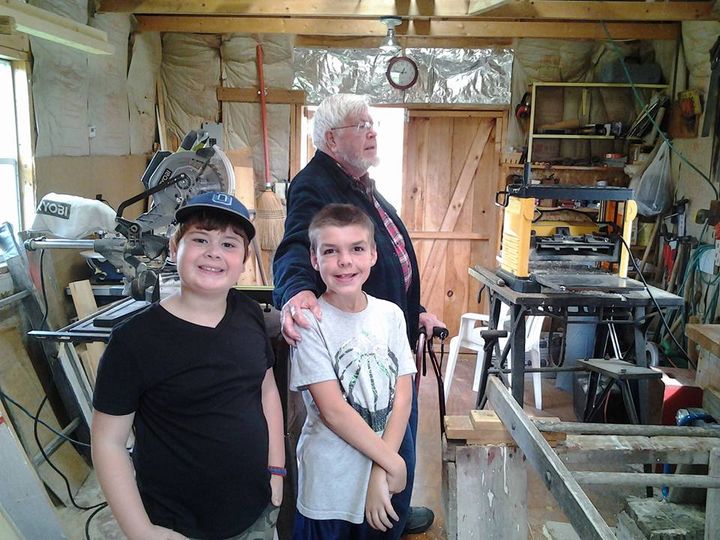
“M got his hair dyed today. I wanted to take a picture, and he resisted. Eventually, he consented. Then I explained why I’m always taking pictures of him and his brother.There isn’t an abundance of photos of my childhood to show them to demonstrate my upbringing and memories. I want it to be different for them. As we talked, and he looked at pictures on my FB account, he found himself lost in laughs and memories, just as I’d hoped.Here’s one from a few years ago, on this day. Grandpa isn’t as active as this anymore, and I want them to remember these things about him.”

When I was reminiscing with my brother last week, we recalled how our Dad, whom we love very much, connected with us differently than we have with our own sons. And my brother said to me that even he wasn’t as intentional with his boys as I’ve been with mine. I guess I have my own reasons for it, which mold and shape me as a father. I’m certainly not perfect! However, I have always had in it in my heart to be intentional in connecting with my sons so that when they are grown up they will remember their childhoods as times of positive interaction with their father (to go with the negative interactions that occur, too).